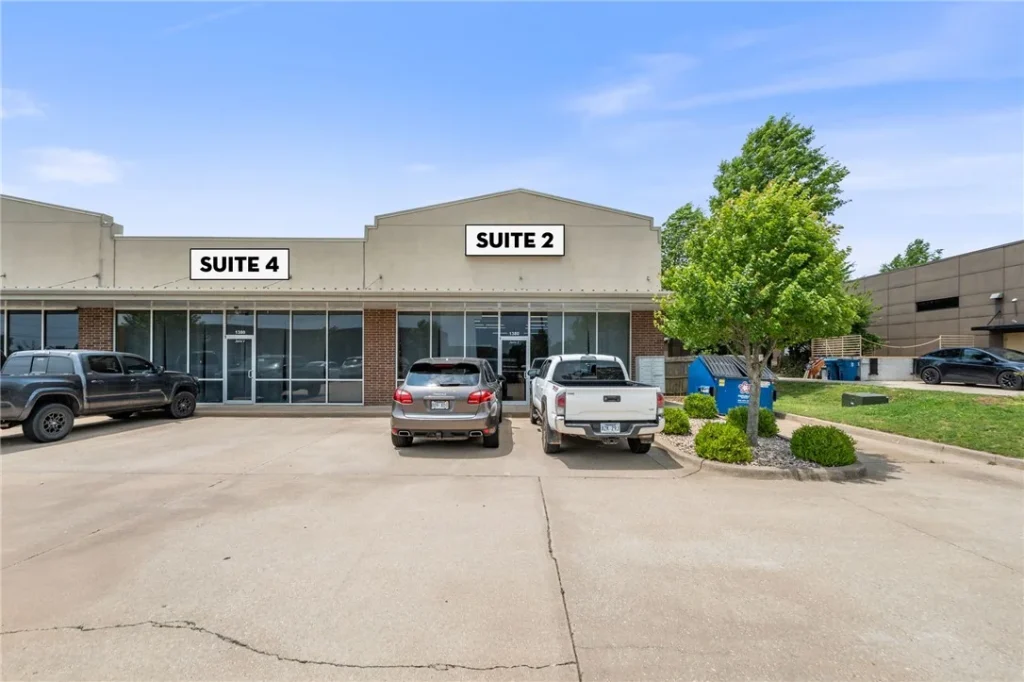
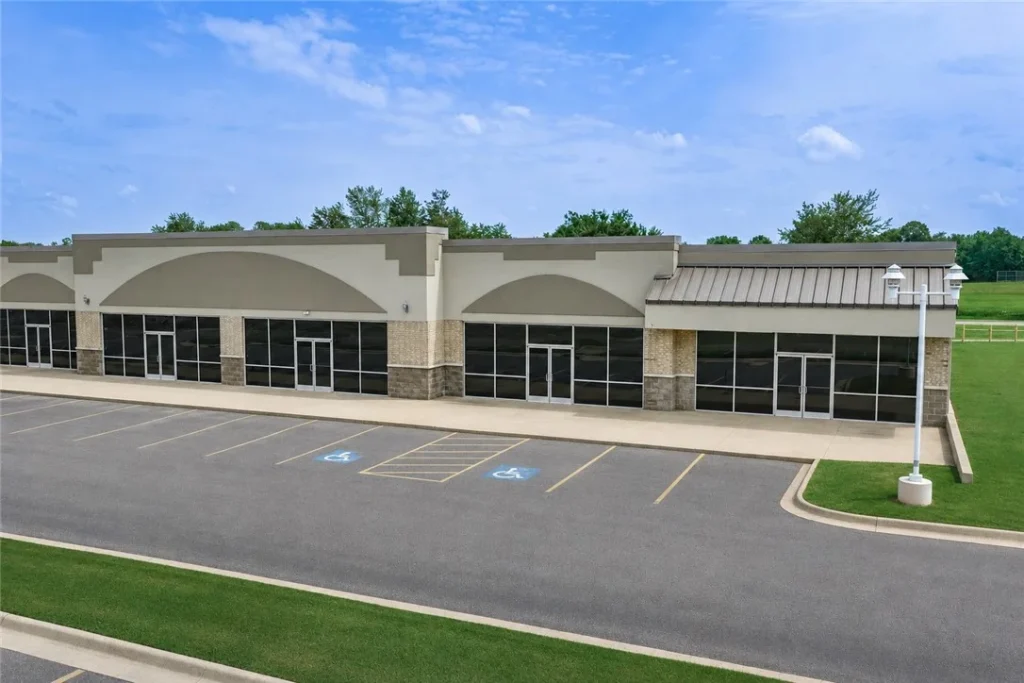
Retail leases don’t read like residential leases, and they don’t behave like office leases either. The document is longer, the cost structure has more moving parts, and the negotiating leverage sits in places most first-time tenants don’t expect. This section walks through the components that show up in nearly every retail lease in Northwest Arkansas, so you arrive at the negotiating table knowing what the numbers actually mean.
Base Rent and the NNN Structure
Most retail leases in NWA are triple net, written as NNN. In a triple net lease, the tenant pays base rent plus three categories of pass-through costs: property taxes, building insurance, and common area maintenance (CAM). The base rent is the headline number quoted in marketing materials. The NNN charges sit on top.
A worked example helps. Imagine a 2,000 square foot inline shop quoted at $22 per square foot in base rent with $6 per square foot in NNN charges. That comes out to:
The lesson: the quoted base rent is rarely the full cost story. Build a budget around the all-in number, not the headline number.
What's in the CAM, Tax, and Insurance Pass-Throughs
The three Ns cover different things, and the line items inside them matter.
Common area maintenance (CAM) covers shared costs across the property: parking lot striping and repairs, common area lighting, landscaping, snow removal, security if provided, property management fees, and utilities for common areas. In a shopping center, CAM is the tenant’s pro-rata share of those costs, calculated as the tenant’s square footage divided by the center’s total leasable square footage.
Property taxes are the tenant’s pro-rata share of the building’s annual property tax bill, again allocated by square footage.
Insurance is the tenant’s pro-rata share of the landlord’s building insurance policy. This does not replace the tenant’s own commercial general liability insurance, which the lease will require separately.
Two negotiating points matter here. First, CAM caps limit how much the controllable portion of CAM can rise year over year, often set at 3 to 5 percent annually. Without a cap, a tenant can absorb double-digit CAM increases driven by costs they have no control over. Second, audit rights give the tenant the legal ability to review the landlord’s CAM accounting and challenge improper charges. Both points are standard asks in any properly negotiated retail lease.
Tenant Improvement (TI) Allowance
The TI allowance is the dollar amount the landlord contributes toward building out the space, quoted in dollars per square foot. The size depends on the condition of the space, the length of the lease, and the tenant’s financial profile.
A few reference points to set expectations:
The TI number is one of the most negotiable items in a retail lease. It trades against base rent, lease term, and the tenant’s credit. A longer lease term usually buys more TI. A stronger tenant credit profile usually buys more TI. Smaller tenants on shorter terms get less, but they should still ask.
Free Rent, Annual Escalators, and Lease Term
Free rent, sometimes called a rent abatement period, is a stretch of time at the start of the lease during which the tenant pays no base rent. This typically covers the buildout period plus a few months of operations, letting the business get to revenue before the rent meter starts. Free rent is negotiable and often tied to lease term length.
Annual escalators raise the base rent each year of the lease. Common structures include a fixed 2 to 3 percent annual increase, or an increase tied to the Consumer Price Index (CPI). Over a 10-year lease, the compounding effect is real. A 3 percent annual escalator on $22 per square foot base rent reaches roughly $28.71 per square foot by year 10.
Exclusivity and Co-Tenancy Clauses
These two clauses protect the tenant from changes inside the property that would damage the business.
Exclusivity prevents the landlord from leasing other space in the same property to a directly competing concept. A coffee shop’s exclusivity clause might prohibit the landlord from signing a second coffee-focused tenant in the same center. Exclusivity language has to be drafted carefully: too narrow, and it doesn’t actually protect the business; too broad, and the landlord won’t agree to it.
Co-tenancy clauses protect the tenant if anchor tenants leave or occupancy drops significantly. In a shopping center anchored by a grocery store and a national soft-goods retailer, if either anchor vacates, the co-tenancy clause may give the tenant rights to rent reduction, lease termination, or operating-hours flexibility. Co-tenancy matters most in anchored centers and matters less in unanchored strip centers or freestanding pads.
Both clauses are heavily negotiated in shopping center deals, and both belong in the LOI rather than getting introduced for the first time in the lease document.
Personal Guarantees
For smaller tenants and newer businesses, the landlord almost always asks for a personal guarantee from the principals. This makes the individuals personally liable for the lease obligations, separate from the business entity. The negotiation isn’t whether to have a guarantee. It’s how to limit it.
Three common structures the tenant should ask for:
- Good guy guarantee. Limits personal liability to a defined period, often 12 to 24 months, as long as the tenant gives proper notice and leaves the space in the condition the lease requires
- Burn-off provision. Reduces the guarantee over time, for example, dropping by 25 percent each year the tenant is current on rent, until it disappears entirely
- Capped liability. Caps the dollar amount the guarantor is on the hook for, rather than leaving exposure equal to the remaining lease term
A first-draft lease will usually propose a full personal guarantee for the full lease term. That is the landlord’s opening position, not the final answer.
Where Tenants Have Real Leverage
A retail lease has six to eight places where the tenant has real negotiating leverage: base rent, NNN cap structure, TI allowance, free rent, lease term and renewal options, exclusivity and co-tenancy, personal guarantee scope, and assignment and sublease rights. Most LOIs focus on the headline base rent number and let the rest get drafted into the lease document later. That is where deals get worse for the tenant.
This is the work a retail tenant representative does: pricing the trade-offs across all of those terms together, not just optimizing the rent number on the first page.